7-67
User
Guide

for

the

Cisco

Application

Networking

Manager

5.2
OL-26572-01
Chapter
7


Configuring

Virtual

Servers
Managing
Virtual

Servers


Displaying
Detailed

Virtual

Server
Information,
page
7-81


Displaying
Virtual

Servers,

page
7-81


Using
the

Virtual

Server

Connection

Statistics

Graph,

page
7-84


Using
the

Virtual

Server

Topology
Map,
page
7-85


Understanding
CLI

Commands

Sent

from

Virtual
Server
Table,
page
7-86
Managing
Virtual

Server

Groups
This
section

describes

how

to

organize

virtual

servers

into

gr

oups,

which

allows

you

to

display

and
manage
a

specific

group

of

vi

rtual

ser

vers

without

having

to

filter

t

he

virtual

server

di

splay.

When
creating
a

group,

you

specify

whether

the

group

is

available

to

just

you

or


is

available

gl

obally

t

o

all
ANM
users.
The
virtual

server

group

feature

is

available

from

the

virtual

servers

operations

window

(Config

>
Operations
>

Virtual

Servers),

which

contains

the

Groups

option

for

managing

object

groups.

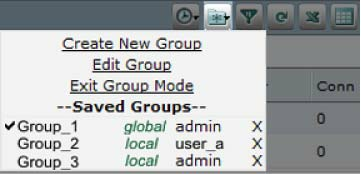
Figure

7-1
shows
the

Groups

icon

with

the

following

available

options

for

managing

object

gr

oups:


Create
New

Group—Adds

a

new

group.


Edit
Group—Modifies

an

existing

group.

This
option
di

splays

onl

y

after
you
sel

ect

a

group

to
display
in

Group

mode.


Exit
Group

Mode—Changes

the

di

splay

from

the

group

mode

display

t

o

the

di

splay

of

al

l

vi

rtual
servers.
This

option

di

splays

onl

y

af

ter

you

sel

ect

a

gr

oup

and

t

he

display

enters

the

Group

mode.


Saved
Groups—Lists

the

currently

configured

groups

along

with

each

group’s

privilege

level
(local
or
global)

and

owner.

From

this

view,

you

can

choose

a

group

to

display

or

delete

a

group.
Figure
7-1
Object
Grouping

for

Virtual

Servers
Guidelines
and

Restrictions
Object
grouping

guidelines

and

restrictions

are

as

follows:


When
you
create
a
global

group,

other

users

can

see

the

group

if

they

have
access
to
at

least

one
object
within

the

group.

This

rule

does

not


apply

to

the

admin

user

or

a

use

r

with

the

anm-admin
role
because

they

have

visibility

to

all

global

groups.


To
edit
or
delete

a

group,

you

must

be

the
group
owner,

a

user
with
the

anm-admin

role,

or

the
admin
user.


When
you
delete
a

locally

authenticated

user

from

the

ANM

database,

ANM

deletes

all

the

global
and
user-specific

groups

that

the

user

created.

However,

when

you

delete

a

remotely

authorized

user
from
the

remote

AAA

server

database,

ANM

does

not

delete

the

groups

that

the

user

created.

In

this
case,
you

must

manually

delete

the

user’s

groups.